Reviewing the Blue Evil Eye for Embroidery Projects
As a designer who spends half my life staring at digitized patterns and the other half watching needles fly across fabric, I have developed a keen eye for what works in the hoop and what looks great on screen but fails in thread. Recently, I took a close look at the Evil Eye, Blue Evil Eye design to determine its viability for real-world applications. This is not just about aesthetics; it is about functionality, stitch quality, and how a design translates from a digital asset into a tangible handmade product.
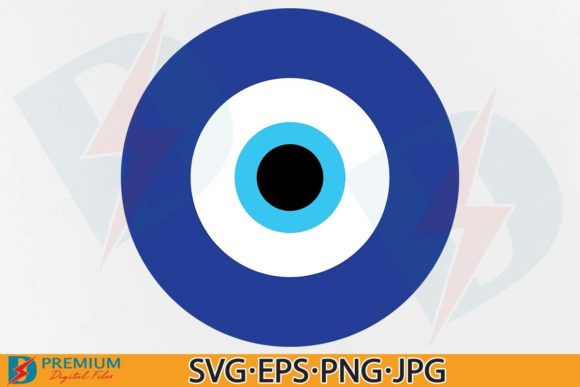
The first impression of this graphic is striking. The blue evil eye is a motif that carries weight. It is protective, mystical, and visually bold. In the context of T-Shirt Designs and general Graphics, it holds its own with strong lines and high contrast. However, when we shift our perspective to embroidery, the conversation changes. We are no longer dealing with pixels that can be infinitely scaled without loss; we are dealing with thread tension, fabric grain, and the physical limitations of the needle.
Visual Impact and Design Personality
The mood created by the Evil Eye, Blue Evil Eye is one of modern mysticism. It fits seamlessly into current trends where spirituality meets streetwear. The layout appears balanced, with the central eye acting as the focal point. For an embroidery designer, this symmetry is a gift. Symmetrical designs tend to hoop better because the pull of the stitches is evenly distributed, reducing the risk of the fabric skewing or the design becoming distorted during stitching.
The detail level seems appropriate for a wide range of projects. It is not so intricate that it requires microscopic precision, which is often a pitfall for home embroiderers, nor is it so simple that it lacks character. This balance makes it a versatile embroidery file for both beginners looking for a forgiving pattern and professionals seeking a reliable staple for their catalog.
Real-World Application: The Custom Tote Bag Scenario
To truly evaluate this design, I imagined a specific client request: a custom embroidered tote bag for a boutique yoga studio. The client wanted something spiritual but modern, something that would appeal to millennials and Gen Z customers. The Evil Eye, Blue Evil Eye was an immediate contender.
In this scenario, the design would likely be stitched onto a heavy canvas or cotton duck fabric. These materials are stable and can handle moderate stitch density without puckering. The blue tones of the eye would pop against a natural beige or white canvas, creating a clean, high-end look. If I were using this as a tote bag design, I would pay close attention to the thread colors. A navy or royal blue would provide depth, while a lighter sky blue might get lost if the lighting is poor. The key here is contrast. The design needs to read clearly from a distance, as tote bags are often carried items that serve as walking advertisements for the wearer’s style.
This same logic applies to sweatshirt embroidery. A crewneck sweatshirt provides a soft, textured background. The Evil Eye, Blue Evil Eye would need to be sized correctly to avoid looking cramped on the chest or overwhelming on the back. For a left-chest placement, a smaller scale works well, acting as a subtle badge of protection. For a full-back design, the details must hold up at a larger size without becoming blocky or losing definition.
Navigating Fabric and Hoop Constraints
While the design is versatile, it is not without its challenges. One must consider where the Evil Eye, Blue Evil Eye should be used carefully. For instance, placing this on a curved surface like a cap requires precise digitizing. If the original file is not specifically optimized for caps, the curvature of the brim can distort the circular shape of the eye, making it look oval or stretched. Always check if your machine embroidery design has been tested on curved surfaces before committing to a production run.
Similarly, textured fabrics present a hurdle. If you are stitching on a fluffy towel or a thick knit, the small details of the eye might get swallowed by the pile of the fabric. In such cases, using a cutaway stabilizer is non-negotiable. It provides the necessary support to keep the stitches flat and visible. For thin or stretchy fabrics, such as those used in baby embroidery or lightweight tees, a lightweight stabilizer and careful tension adjustments are crucial to prevent the fabric from gathering around the design.
Another critical factor is the hoop size. While the design may fit within a standard 4x4 or 5x7 hoop, you must ensure that there is enough margin around the edges. Crowding the hoop can lead to needle strikes or uneven stitching at the borders. Always measure twice and hoop once.
Commercial Viability and Customer Trust
For Etsy sellers and small shop product creators, the visual appeal of a design directly impacts sales. The Evil Eye, Blue Evil Eye has high recognition value. People understand the symbol instantly, which reduces the cognitive load for the buyer. They do not need to decipher what they are looking at; they simply feel the vibe. This immediacy can boost buyer engagement and conversion rates.
However, professionalism is key. A poorly stitched evil eye can look menacing rather than protective. Ensuring that the finished product is clean, with no loose threads or jumped stitches, builds customer trust. When you deliver a high-quality personalized gift or custom apparel, you are selling an experience. The design is the hook, but the execution is the retention strategy.
Using this design in commercial embroidery projects also requires due diligence regarding licensing. Since the product description mentions digital files, including PNG and JPG formats, it is essential to confirm whether these graphics are intended for print-on-demand, sublimation, or if they accompany a separate embroidery file format like PES or DST. The description lists a ZIP file with PNG and JPG assets, which are primarily for printing or digital mockups. If you intend to stitch this, you must ensure you have the correct vector or embroidery-specific file format. Using a raster image like a PNG for embroidery conversion can result in poor stitch paths unless manually digitized by a professional.
Practical Designer Notes for Best Results
Before launching this design into your production line, consider these practical steps:
- Test on Scrap Fabric: Never stitch a new design directly on your final garment. Use a similar fabric scrap to test tension and density.
- Check Thread Contrast: Lay out your thread spools next to the fabric. Ensure the blues of the eye stand out against the background color.
- Review Stitch Density: If the design feels too stiff after stitching, the density may be too high for lightweight fabrics. Adjust accordingly.
- Inspect Small Details: Zoom in on the digital file. Are the lines clean? Are there any tiny elements that might break during washing?
- Mockup Testing: Create black and white mockups to see if the design holds its shape without color reliance. This helps identify structural weaknesses in the layout.
- Confirm Licensing: Verify if the license allows for commercial use of the finished items. This is crucial for craft business owners selling on platforms like Etsy.
In conclusion, the Evil Eye, Blue Evil Eye is a compelling choice for designers looking to add a touch of mystical flair to their collections. Whether used for holiday embroidery, embroidered patch creation, or everyday apparel decorators projects, it offers a strong visual identity. By respecting the technical constraints of embroidery and understanding the material interplay, you can transform this digital asset into a cherished physical object. Remember, the best designs are those that not only look good on the screen but survive the journey through the needle and into the hands of the customer.